How to Start and Run a Water Delivery Business
Most guides stop at registering the company. This one covers the part that decides whether you make money: recurring and one-time orders, bottle deposits, drivers and payments, every day.
By Saima · · 13 min read
Most advice on how to start a water delivery business covers the paperwork: register a company, buy a truck, get insurance. You do need those things, but they are not what decides whether the business survives its second year. That comes down to the daily routine. Regular customers expect their bottles on the same day every week. One-time orders come in by phone and message. Empties have to come back. Drivers have to deliver the right orders and bring back the right amount of money.
This guide covers both parts: setting up a water delivery business properly, and running it once you have more customers than you can track from memory. It is written for operators anywhere, whether you deliver 5-gallon jugs in Texas, 19-litre bottles in Lahore, Dubai or Nairobi, or 20-litre jars in Bengaluru.
About the numbers in this guide: Costs, prices and rules vary widely between countries and cities. Example figures here are illustrations to show a method, not market data. Use local quotes and confirm the rules where you operate.
What a water delivery business actually sells
You are not really selling water. Treated water is cheap almost everywhere. You are selling reliability: the right bottles at the right door on schedule, without the customer having to chase you.
That is why the business suits recurring deliveries. A household that takes two bottles a week, or an office that takes twenty, will reorder for years if you never let them run dry. Most of the steady income in water delivery comes from these standing orders. One-time orders fill the gaps, such as an event, a new customer trying you out, or a regular who ran out early.
Your systems need to handle both from day one.
Step 1: Choose your business model
"Water business" covers several distinct models:
- Bottle-and-deliver. You run your own purification and filling (RO, UV, ozonation) and deliver large reusable bottles (5-gallon, 18.9-, 19- or 20-litre) to homes and offices. This needs the most capital and the most regulation, and gives you the most control over margin.
- Distributor or reseller. You buy filled bottles from a licensed bottler or brand and own the delivery route and the customer relationships. You can start faster with less equipment, at thinner margins.
- Water station or refill shop. Customers bring containers to you, and you may add local delivery. This is common in the Philippines, Latin America and parts of the US.
- Cooler and dispenser rental with delivery. Common with offices. You earn from both the rental and the water.
- Bulk water by tanker. A different business with different equipment and customers (construction, estates, areas without piped water). It is not covered in detail here.
Most small operators start with the first or second model, because standing household and office orders create predictable income. The rest of this guide focuses on those.
Step 2: Meet the regulations where you operate
Drinking water is a food product in most countries, and bottled water is regulated accordingly. The details differ, so treat the following as a starting map, not legal advice:
- United States: the FDA regulates bottled water as a food. The FDA's overview explains its role. Processing and bottling rules are in 21 CFR Part 129, and quality standards in 21 CFR 165.110. States add their own licensing.
- United Kingdom (England): bottled drinking water falls under The Natural Mineral Water, Spring Water and Bottled Drinking Water (England) Regulations 2007, enforced locally.
- India: packaged drinking water generally requires BIS certification and an FSSAI food licence.
- Pakistan: bottled water has long been on PSQCA's compulsory certification list. Provincial food authorities also test and seal brands. See our Pakistan-specific guide.
- Gulf states, Africa, Southeast Asia and elsewhere: look for the national food or standards authority, such as the Saudi Food and Drug Authority, and the municipal licence for the premises.
Whatever the country, plan for three things: a licence or certification for the product, approval for the premises, and regular lab testing with records you keep. Office and corporate customers often ask to see test reports before they sign.
If you are a reseller rather than a bottler, ask your supplier for their certification and test reports. Your customers will hold you responsible for the water either way.
Step 3: Pick a delivery area and customer mix
New operators tend to accept every customer who calls. The better approach is to choose an area you can serve reliably and grow outward from it.
Households order one or two bottles a week, cluster in residential areas and often pay per delivery or monthly. Offices, shops, clinics, schools and gyms order more per stop, are more predictable and may want invoices and credit terms. They can also pay slowly.
Delivery density matters more than coverage. Twenty customers on four streets are far cheaper to serve than twenty spread across a city. Mark your area on a map, serve it well, and add a second area when you have the volume to justify a second route or driver.
Step 4: Price each delivered bottle, not the water
The most common pricing mistake is starting from the cost of the water. When you set a price per bottle, include everything it takes to get a full bottle to the door and the empty one back:
- Water treatment: power, filters, membranes, chemicals, lab tests
- Bottles and caps, including breakage and bottles that are never returned
- Driver wages, fuel, vehicle costs and parking
- Rent for the plant or warehouse
- Your own time on orders, customer calls and collections
- Money tied up in unpaid customer balances
An illustrative calculation (not real prices): if your monthly costs total 6,000 and you deliver 2,000 bottles a month, each delivered bottle costs you 3.00 before profit, in whatever currency you use. If local competitors charge less than that, you need more bottles per stop, a denser area or a different customer mix. Cutting prices and hoping for volume will not fix it. Recalculate every few months as fuel and power prices move.
Step 5: Treat bottles and deposits as working capital
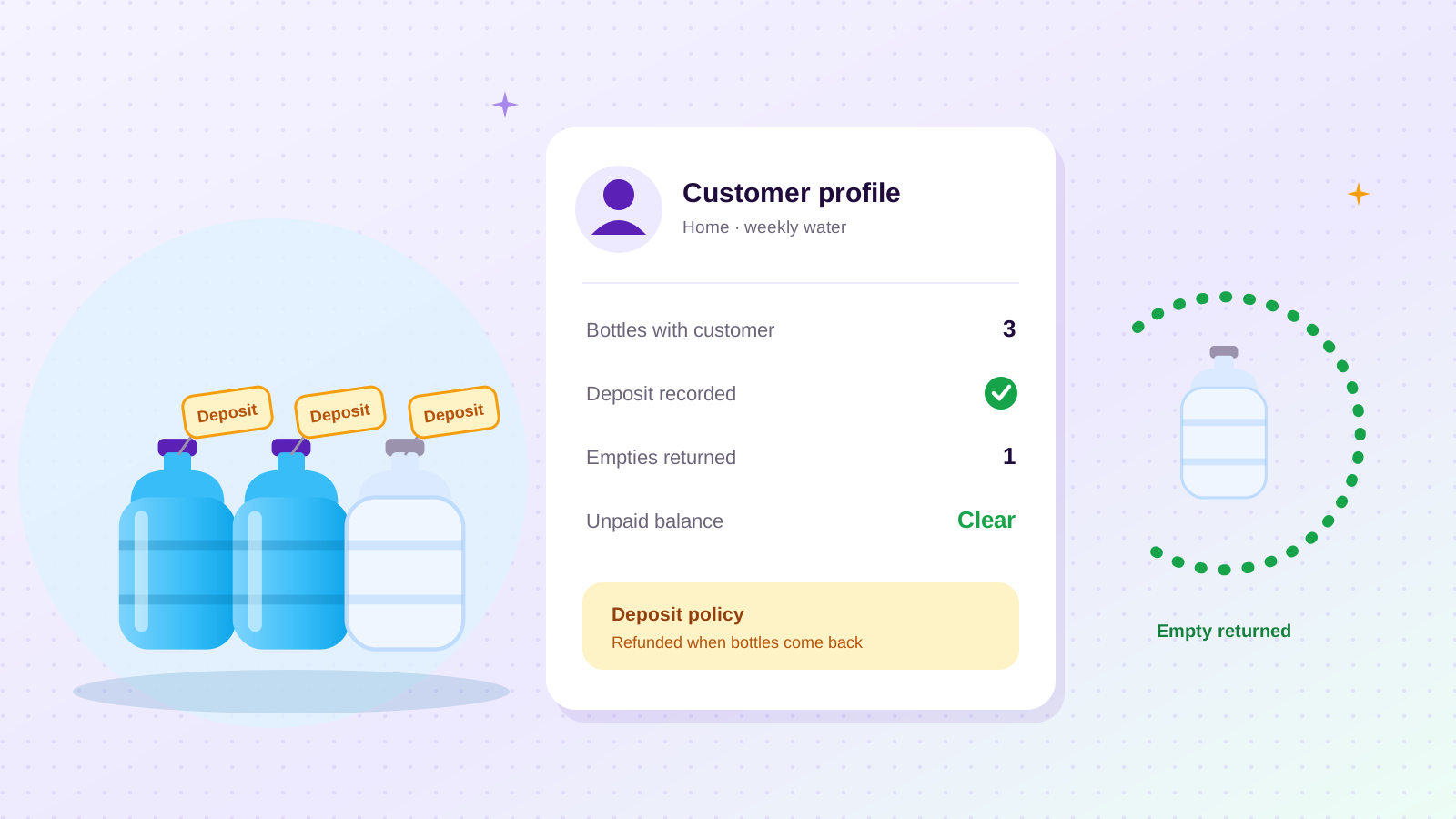
Reusable bottles are expensive, and every one sitting empty in a customer's home is one you cannot fill and sell. Most operators charge a bottle deposit or include bottles in a rental agreement. Whichever you choose, write the policy down and apply it to every customer the same way:
- What is the deposit per bottle, and is it refundable?
- How many bottles can a customer hold at once?
- What happens when a bottle is damaged or never returned?
- When a customer cancels, how is the deposit settled against anything they still owe?
Record each deposit against the customer at the moment you take it. Most deposit disputes happen months later, when nobody can remember who paid what.
Step 6: Run recurring and one-time orders from one system
This is where most growing water businesses start to struggle. Both order types need to flow into the same daily delivery list.
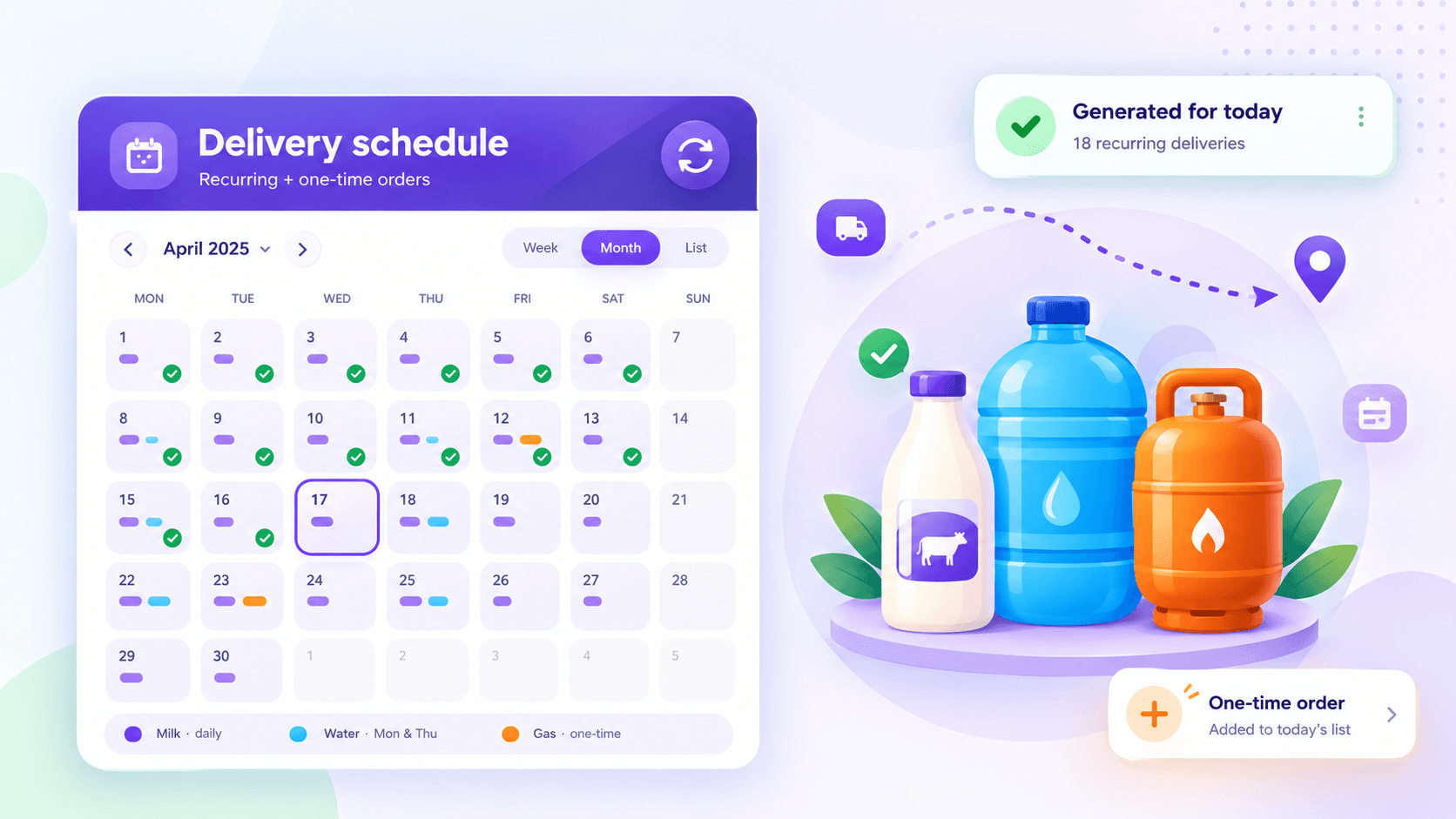
Recurring orders ("two bottles every Monday", "ten bottles every weekday") should be set up once as a standing schedule. Each day's deliveries are then generated from those schedules. Writing them out again by hand every day is how deliveries get skipped, and a skipped recurring delivery is how you lose a customer without warning.
One-time orders arrive by phone, message or a customer app. They should go into the same list as soon as they come in, not onto a sticky note.
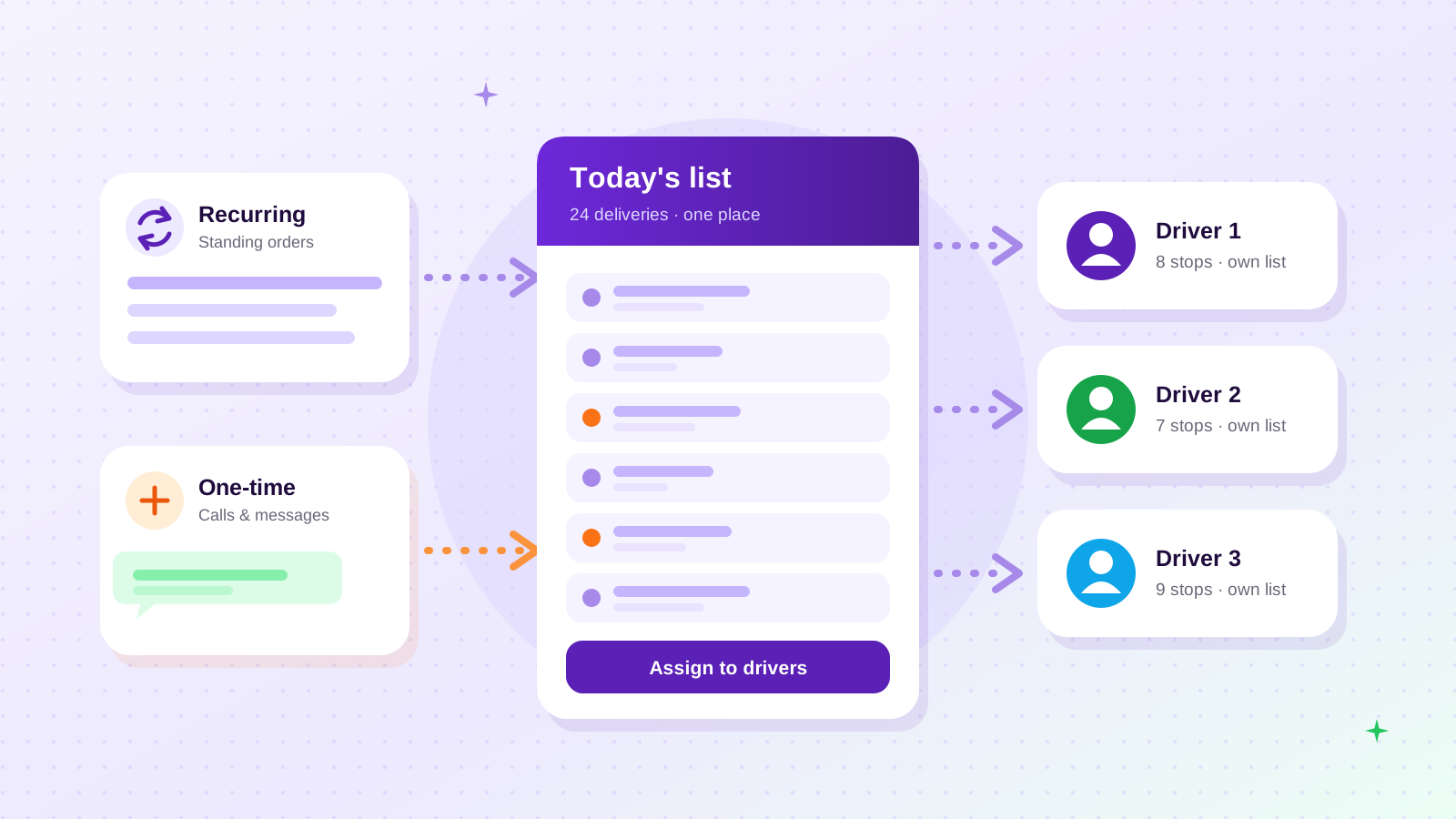
A daily routine that works at almost any size:
- Keep one customer list with each customer's address(es), standing order, deposit and current balance.
- Review the day's list before drivers leave, with recurring and one-time orders together, and handle skips and holds (a customer away on holiday, an office closed).
- Assign each delivery to a specific driver, so each driver has their own list.
- Mark deliveries as completed when they happen, not from memory at the end of the day.
- Check what is still pending mid-morning and mid-afternoon, so late deliveries are caught before the customer calls.
You can do this on paper, in a spreadsheet or in an app. The principle is one shared record that you and your drivers all work from. We go deeper on this in how to manage recurring deliveries and one-time orders together.
Step 7: Control payments and driver cash
How customers pay depends heavily on where you operate. In the US, UK and much of Europe, most customers pay by card or bank transfer on an invoice or subscription. In much of South Asia, the Middle East, Africa and Latin America, cash on delivery and monthly cash settlement are still common, often alongside mobile wallets.
If your drivers handle cash, three gaps cause most losses:
- Payments that are never recorded. A customer pays the driver against their balance, it doesn't get written down, and next month you ask them for money they already paid.
- Unclear driver handovers. A driver returns with cash at the end of the day, and you have no way of checking it against what was actually collected.
- Balances nobody is chasing. Small unpaid amounts spread across many customers quietly add up to a large sum.
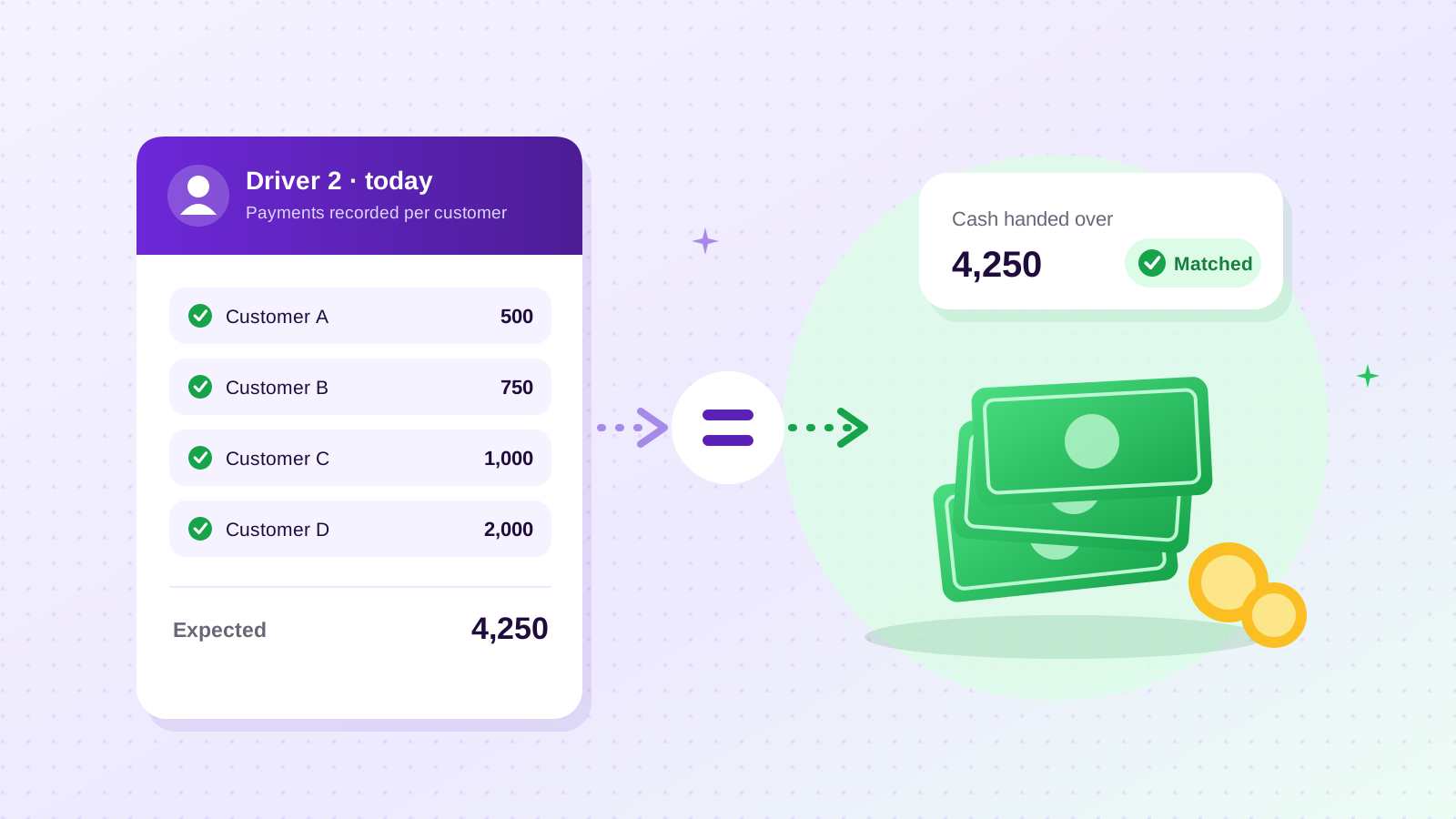
A simple daily routine: record every payment against the specific customer when it is received. At the end of the day, compare each driver's recorded collections with the cash they hand over, and settle any difference that day. Once a week, review unpaid balances, oldest first.
Even if you are fully cashless, the same discipline applies to failed card payments and overdue invoices.
A hypothetical example: an operator with 150 customers believes about 1,000 is outstanding. When every delivery and payment is put into one ledger, the real figure is closer to 1,600, spread across dozens of small amounts nobody was tracking. Gaps like this are common when records live in several places, and they only show up when everything is in one place.
Step 8: Know when to move from a notebook or spreadsheet to software
Notebooks and spreadsheets are free and familiar, and they are fine for the first few dozen customers. These signs mean you have outgrown them:
- Recurring deliveries are regularly missed or delivered twice.
- Customers dispute balances, and you can't show their history quickly.
- You can't say at the end of the day how much each driver should hand over.
- Only one person knows the real state of the business.
- Taking on new customers feels stressful rather than exciting.
What to look for in water delivery business software
The right tool depends on your size and market. Large fleets often need route optimisation and card billing. Smaller operators usually need something simpler. Check whether the software:
- Works on a phone for you and your drivers
- Creates recurring orders automatically from standing schedules, alongside one-time orders
- Keeps customer profiles with addresses, order history, balance and deposit
- Gives each driver their own login with only their deliveries
- Records payments in your real payment mix (cash, transfer, card) and driver handovers
- Lets you define your own products and prices, such as bottle sizes and dispensers
- Supports your currency and keeps your data private from other businesses
- Fits your budget at your current size, not only at fifty drivers
Run one real week of deliveries through any tool before committing, including the awkward cases: a skipped recurring order, a partial payment, a driver swap.
How 4Supplier helps water delivery businesses
4Supplier is a mobile app for suppliers who deliver products to customers, either on a recurring schedule or as one-time orders. Typical users deliver bottled water, milk or gas cylinders. Here is what it does today:
- Recurring and one-time orders created from your product list, with quantity, price and delivery time. Recurring orders are generated automatically on the schedule you set, and you can optionally have them cancel automatically if they aren't confirmed by a cutoff you choose.
- Order filters (all, unassigned, pending, completed) so you can see what is still due.
- Customer profiles with contact details, multiple delivery addresses, order history, total spent, unpaid balance and security deposit.
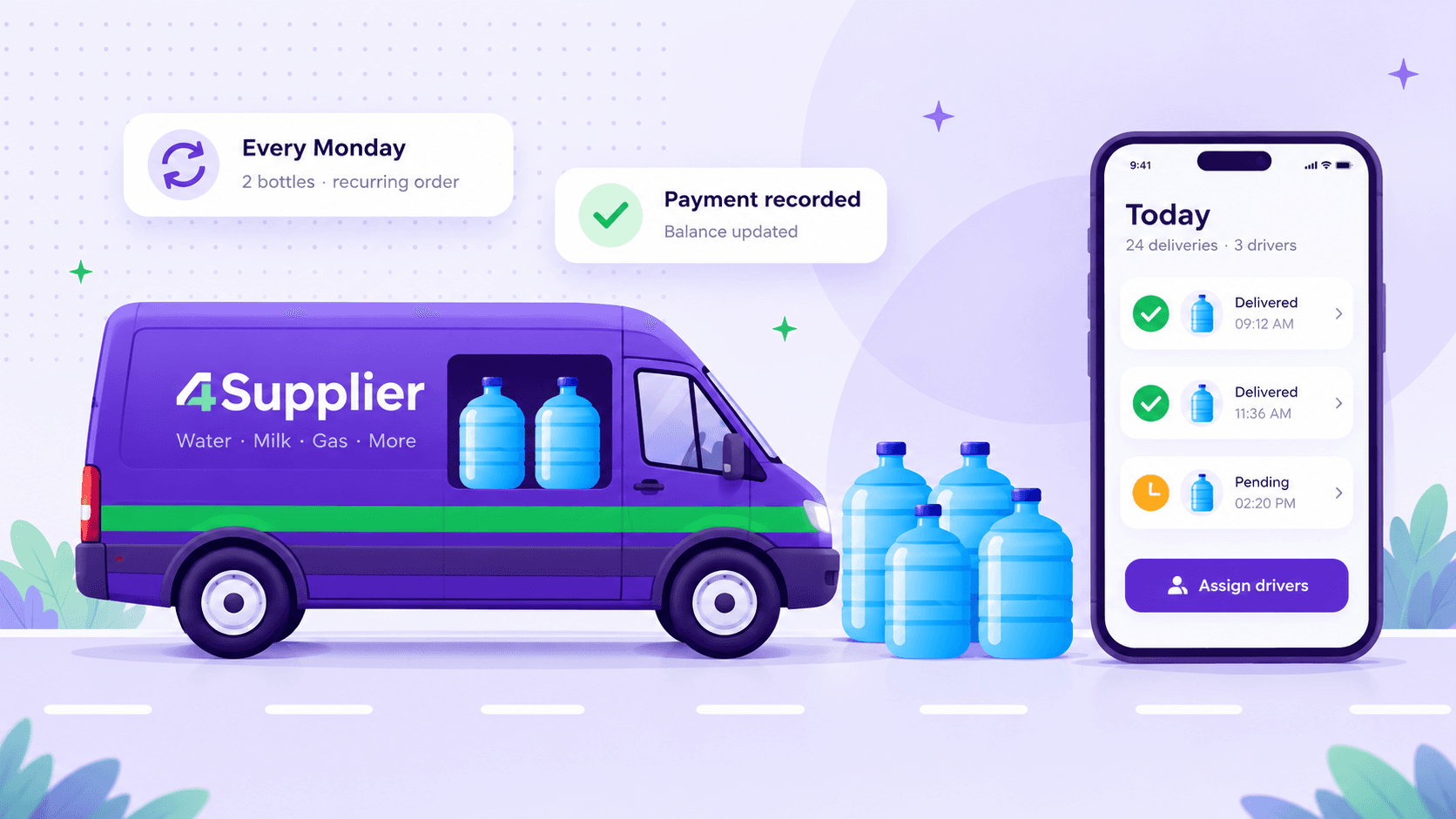
- Driver accounts. Assign or reassign orders, and each driver logs in and sees only their own pending and completed deliveries.
- A wallet that records income, expenses, customer payments, deposits and the cash each driver collects and hands over. Each entry is linked to a customer, order or driver, and balances go down as payments are recorded.
- A product catalog with categories and size or price variants.
- Separate logins for you, your drivers and, optionally, your customers. Your data is not visible to other suppliers on the platform.
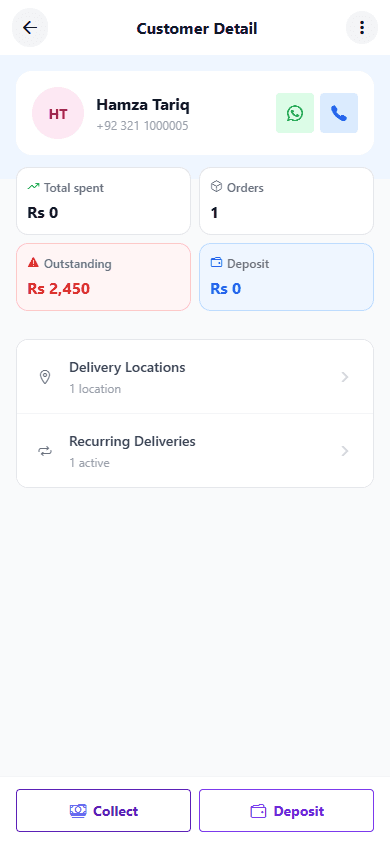
To set expectations: 4Supplier records payments for bookkeeping but does not process card or bank payments itself, and it does not continuously track driver locations or optimise routes. It is being built for Android and iOS and is not yet available on Google Play or the App Store. The shorter product page is water delivery. You can see how it works and browse the app screens now.
Common mistakes when starting a water delivery business
- Covering too large an area before there is enough volume
- Pricing from the water cost instead of the cost per delivered bottle
- Taking bottle deposits without recording them against the customer
- Writing recurring orders out by hand every day
- Letting unpaid balances run for months
- Stopping regular lab tests once the business is running
- Keeping the whole operation in the owner's head
Frequently asked questions
Is a water delivery business profitable?
It can be, but profit depends more on operations than on the cost of the water. Delivery density, bottle losses, driver costs and how quickly customers pay usually decide the margin. Work out your full cost per delivered bottle before setting prices.
How much does it cost to start a water delivery business?
It varies enormously by country and model. A reseller with one vehicle needs far less than an operator building a purification and filling plant. Get local quotes for equipment, bottles, premises, a vehicle and certification. Keep working capital for bottle stock and unpaid balances in the first months.
Do I need a licence to sell bottled or delivered drinking water?
In most countries, yes. Bottled water is usually regulated as a food, and both the product and the premises need approval. Check with your national food or standards authority and your local municipality.
How do I manage recurring water deliveries?
Set each regular customer's standing order up once, generate each day's deliveries from those schedules, and add one-time orders to the same list. Review the list before drivers leave, and handle skips and holds there.
How should bottle deposits work?
Use a written policy covering the deposit per bottle, how many bottles a customer may hold, and what happens to lost or damaged bottles. Record each deposit against the customer, and settle it against any balance when they cancel.
What software do water delivery businesses use?
Larger fleets often use route-optimisation and subscription-billing platforms. Smaller operators usually need a phone-first tool that handles recurring and one-time orders, customer balances, deposits, driver lists and payment records.
Delivering milk, gas or something else?
The same routine applies to any business built on recurring and one-time deliveries: standing orders set up once, one shared daily list, a driver list for each driver, deposits recorded, and every payment tied to a customer. Only the product and the regulations change.
Build the routine first, then grow
A water delivery business rarely fails because water is expensive to produce. It fails when recurring deliveries are missed, bottles disappear, balances go unchased and nobody knows how much cash should be in the drawer. Get the licensing and testing right, start in a compact area, price for every cost, and run recurring and one-time orders from one shared record.
If you already deliver and your notebook or spreadsheet is starting to slip, see how 4Supplier organises customers, orders, drivers and payments. Questions about whether it fits your business can go to info@nsians.com.