Starting a Water Supply Business in Pakistan: What Is Different Here
What changes when you run a water supply business in Pakistan: PSQCA and provincial food authorities, pricing 19-litre bottles in rupees, bottle deposits, WhatsApp orders and rider cash.
By Saima · · 7 min read
The basics of a water delivery business are the same everywhere: pick a model, price each delivered bottle properly, and run recurring and one-time orders from one shared record. Our general guide to starting a water delivery business covers those steps.
This article covers what is specific to Pakistan. Licensing runs through PSQCA and the provincial food authorities. Customers expect home delivery of 19-litre bottles. Orders arrive on WhatsApp. And a large share of payments still come in as cash through your riders.
A note on figures: Many costs quoted online for Pakistan's water business are years old. Example numbers below are illustrations of a method, not market data. Get current quotes and confirm current rules with the authorities named here.
Why so many people start water businesses in Pakistan
Many households and offices in Pakistan's cities do not trust tap water, so they buy filtered or bottled water every week. Demand is steady, customers reorder on a schedule, and a small RO plant with home delivery is within reach for many first-time business owners. That is why searches like "mineral water business in Pakistan" and "water plant business profit" are so common.
The same popularity brings intense competition and close scrutiny. The Pakistan Council of Research in Water Resources (PCRWR) publishes quarterly bottled water reports naming brands found unsafe. Provincial food authorities run their own testing drives; see, for example, the KP Food Safety & Halal Food Authority's bottled water reports. A small brand that appears on one of these lists can lose its customers overnight.
Licensing: PSQCA and provincial food authorities
Treat this as a checklist to confirm, not legal advice. Requirements have changed over the years and differ by province.
- PSQCA. Bottled water has long been on the Pakistan Standards and Quality Control Authority's compulsory certification list. Dawn reported this in 2002. A 2017 ProPakistani report said purification plants need a PSQCA no-objection certificate and should not be set up in residential areas. Confirm the current process, fees and location rules with PSQCA.
- Provincial food authority. Punjab, Sindh, KP and Balochistan each have a food authority that can inspect, test and seal water businesses. Find out which one covers your plant and what it requires.
- Lab testing. Test at an accredited lab before launch and on a fixed schedule after that. Corporate clients, schools and hospitals often ask for recent reports.
- Registration and tax. Register the business, open a separate bank account, and ask a tax adviser about FBR and provincial sales-tax obligations for your size.
If you resell another plant's bottles instead of filling your own, ask to see that plant's PSQCA certification and recent test reports. Your customers will blame you for bad water either way.
Customers: homes, offices and the WhatsApp order
Most small suppliers in Karachi, Lahore, Islamabad, Rawalpindi and other cities serve a mix of:
- Households taking one or two 19-litre bottles a week, often in dense residential blocks and apartment buildings
- Offices, shops, clinics and schools taking more bottles per stop, sometimes on monthly credit
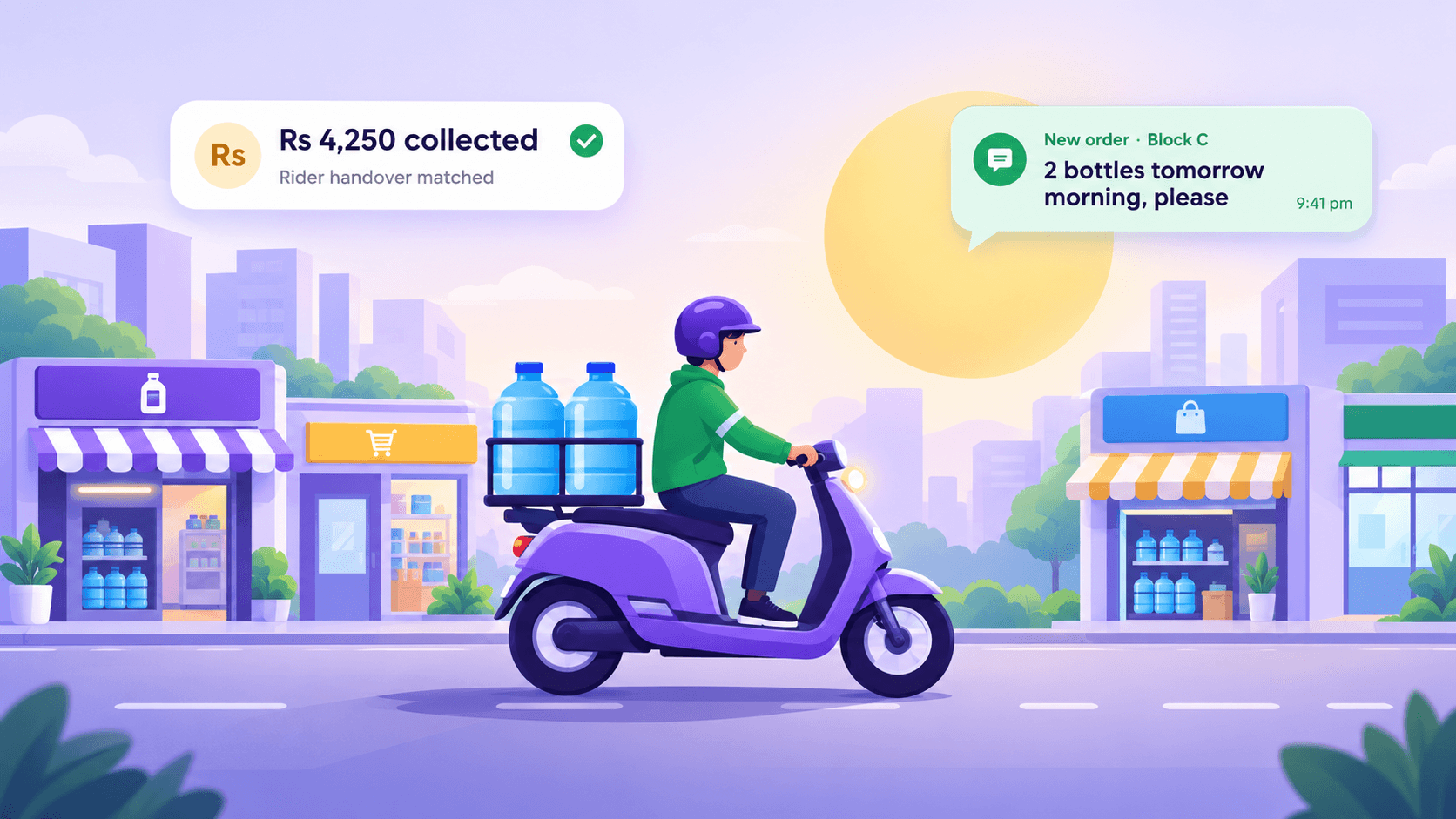
Orders typically arrive as WhatsApp messages and phone calls, often in the evening for the next morning. The risk is that these one-time orders live only in your chat history. Copy every order into the same daily list as your regular customers' standing orders as soon as it arrives, so nothing depends on scrolling back through messages.
Keep your area compact. A rider who can do thirty drops in two neighbouring blocks earns you far more than one crossing the city for the same thirty.
Pricing a 19-litre bottle in rupees
Price the delivered bottle, not the water. In Pakistan, a few costs are easy to underestimate:
- Electricity and load-shedding backup for the RO plant
- Fuel for motorbikes or loaders, which moves with petrol prices
- Bottle losses: bottles that break, are never returned, or come back unusable
- Rider wages and the time riders spend on stairs in buildings without lifts
- Unpaid balances from customers who settle at the end of the month, or later
An illustrative calculation (not real market prices): if your monthly costs total Rs 300,000 and you deliver 4,000 bottles a month, each delivered bottle costs Rs 75 before profit. If competitors in your area charge less, look at delivery density, bottles per stop or your customer mix before cutting your price. Recalculate after every major fuel or electricity price change.
19-litre bottle security deposits
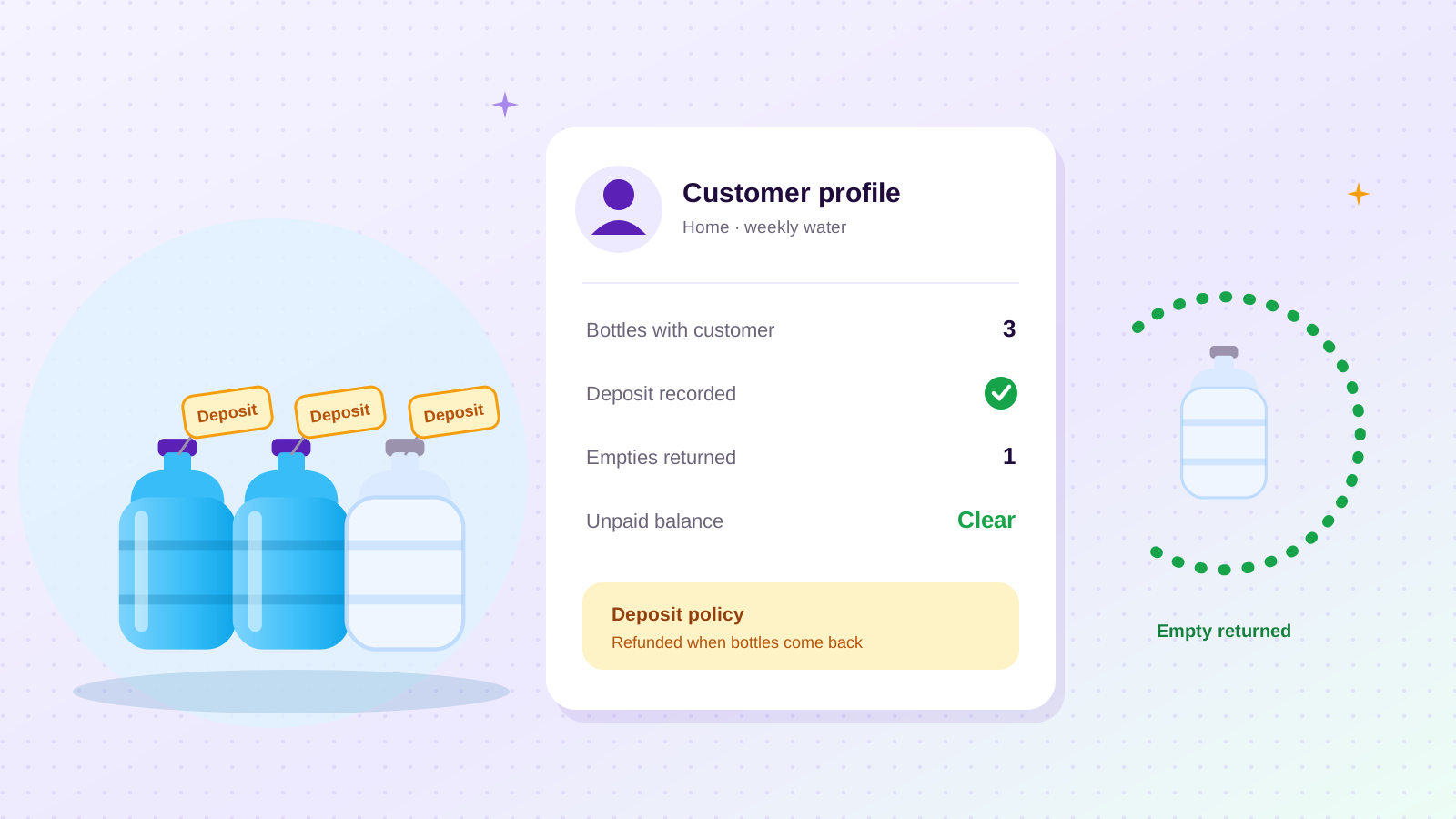
Many suppliers take a security deposit when a customer receives their first bottles. Write the policy down and apply it the same way to everyone: the amount per bottle, how many bottles a customer may hold, what happens to a lost or cracked bottle, and how the deposit is settled when a customer leaves owing money. Record the deposit against the customer the moment you take it. Most deposit disputes surface months later, when a customer moves house.
Riders and cash: the part most guides skip
Cash is still how many households in Pakistan pay for water, either on delivery or as a monthly settlement with the rider. That makes rider cash the biggest operational risk in the business.
The usual problems are familiar to anyone who has run deliveries:
- A customer pays the rider against their balance, it never gets written down, and next month you ask them for the same money.
- A rider hands over a bundle of notes at night, and you have no way of checking it against what was actually collected.
- Small unpaid amounts across dozens of customers add up to a sum nobody is chasing.
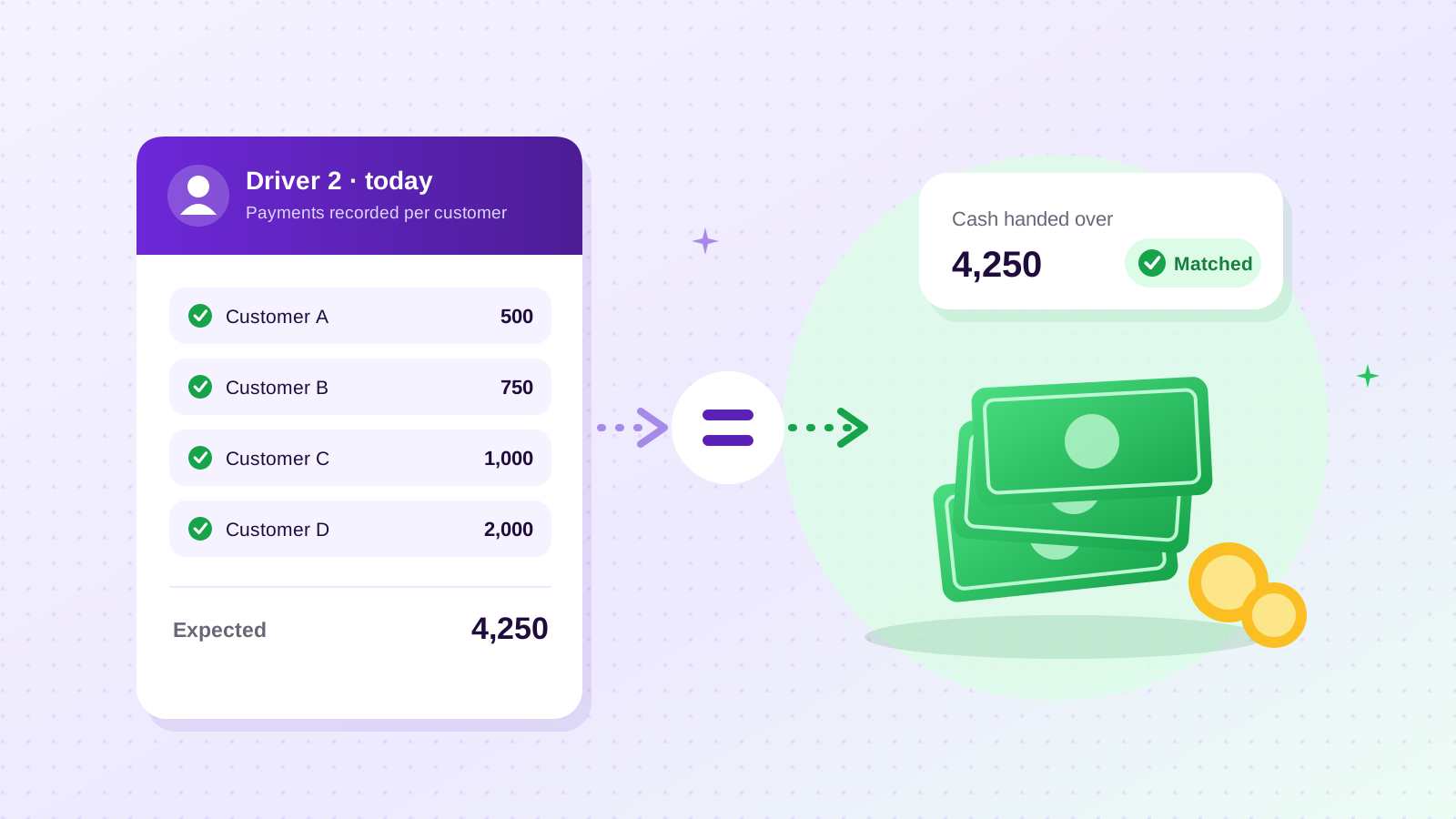
A daily routine that works: record every payment against the specific customer when it is received, by you or by a rider. At the end of the day, compare each rider's recorded collections with the cash handed over, and settle any difference the same day. Once a week, review unpaid balances, oldest first. Mobile wallet and bank transfers should be recorded the same way, so every customer's balance reflects every payment method.
When the register stops working
A khata-style register works well for a few dozen customers. You have outgrown it when regular customers' weekly bottles get missed, balance disputes become common, you can't tell how much cash each rider should hand over, or only you know the true state of the business. At that point, move your records into software. The checklist in our general guide explains what to look for. For Pakistan specifically, prioritise:
- A phone-first app for you and your riders
- Recurring orders created automatically, alongside one-time WhatsApp orders
- Customer balances and security deposits on every profile
- Recording cash payments and rider handovers, not only online payments
- Rupee pricing and your own bottle sizes and products
How 4Supplier fits a Pakistani water supplier
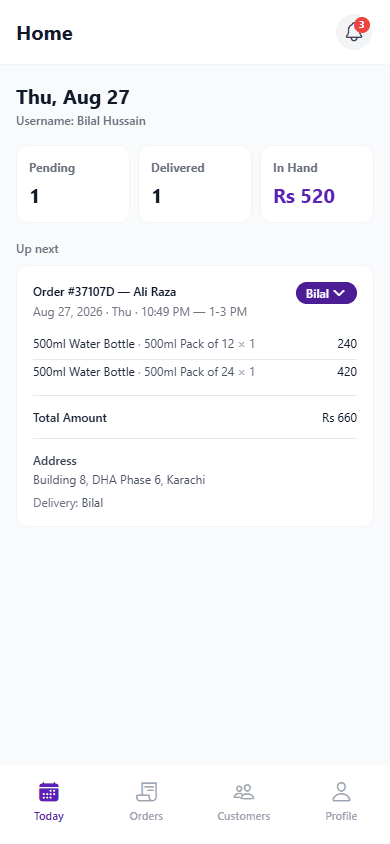
4Supplier is a mobile app for suppliers who deliver products such as water, milk and gas cylinders. For a water supplier it provides:
- Customer profiles with addresses, order history, unpaid balance and security deposit
- Recurring and one-time orders from your product list, with recurring orders generated automatically
- Separate rider logins where each rider sees only their own deliveries, with assignment and reassignment from your phone
- A wallet that records customer payments, deposits, expenses and the cash each rider collects and hands over
- A product catalog with sizes and prices that you set, and currency settings
It records payments for bookkeeping but does not process card or bank payments. It is being built for Android and iOS and is not yet on Google Play or the App Store. A shorter product page is suppliers in Pakistan. You can see how it works now, or write to info@nsians.com with questions.
Frequently asked questions
Is the water supply business profitable in Pakistan?
It can be, but profit depends more on operations than on the cost of water. Delivery density, bottle losses, rider costs and how quickly customers pay usually decide the margin.
Do I need a PSQCA licence to sell bottled water in Pakistan?
Bottled water has been on PSQCA's compulsory certification list for many years, and purification plants have needed PSQCA approval. Provincial food authorities apply their own requirements too. Confirm the current rules with both before you start.
How much does it cost to start a water plant business in Pakistan?
Published figures are often several years old. Get current quotes for the RO system, bottles, filling equipment, premises and a delivery vehicle. Keep working capital for bottle stock and unpaid customer balances in the first months.
How do I stop cash going missing between riders and customers?
Record every payment against the customer when it is received. Then compare each rider's recorded collections with the cash they hand over every evening, and settle any difference the same day.