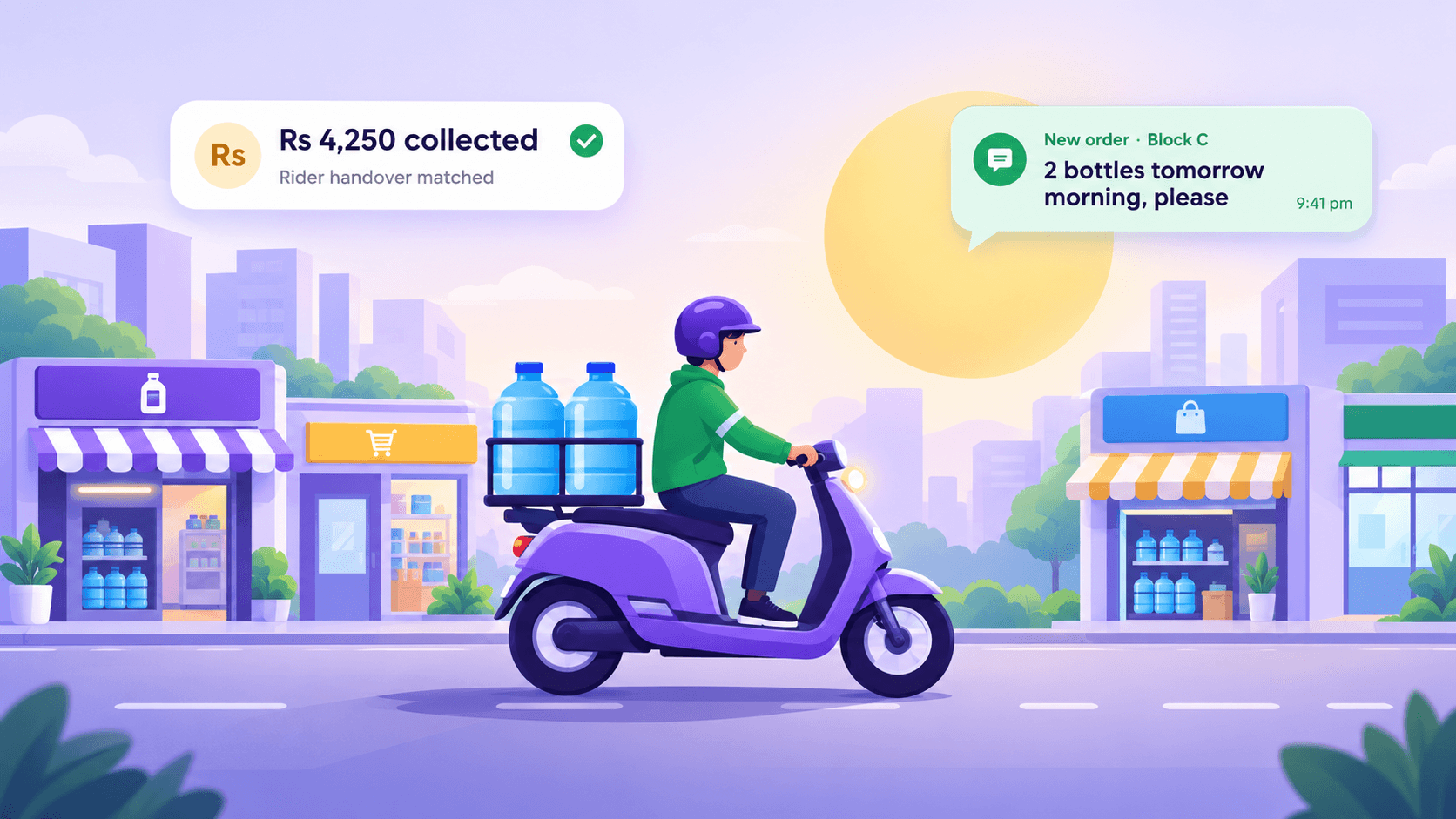
How Delivery Management Software Helps Water, Milk and Gas Suppliers in India
Registers, repeat order calls, monthly milk bills and delivery boys handing over cash at night. What delivery management software actually changes for Indian water, milk and gas suppliers, and how to choose one.
By Saima · · 14 min read
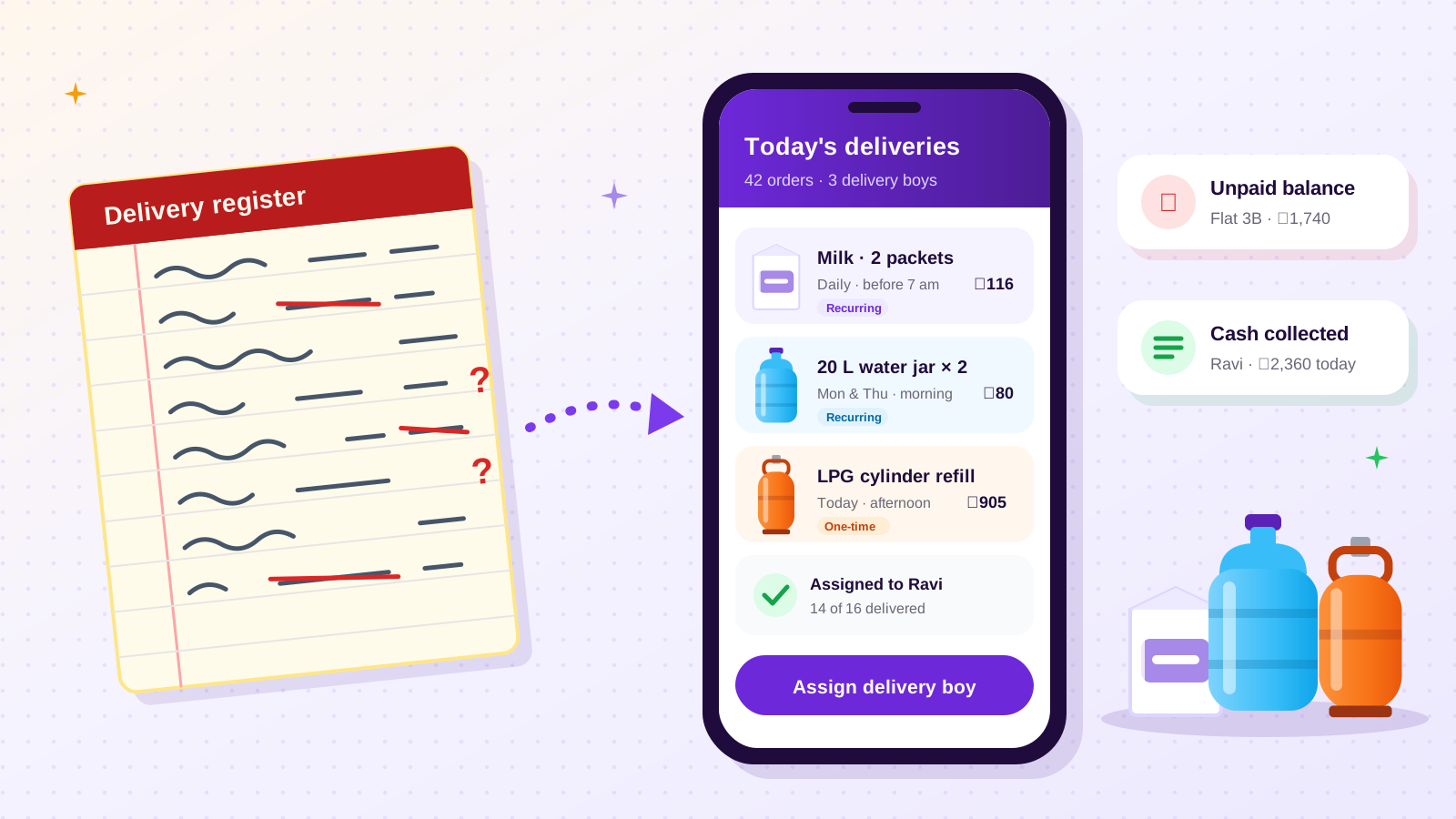
It is 6 am and the phone has already rung four times. One customer wants an extra 20-litre jar today. Another is going to her mother's place for a week and wants milk stopped from tomorrow. A restaurant asks when its gas cylinder is coming. Before answering any of them properly, you open the register to check yesterday's entries, then try to remember whether the flat on the third floor paid last month or only said they would.
Then the delivery boys arrive and you read out the day's list, or forward it on WhatsApp, and hope nothing was missed.
If that sounds familiar, this guide is for you. It looks at how water, milk and gas suppliers in India usually run their orders and accounts, where those methods start to break, and what delivery management software can and cannot fix. It ends with a checklist you can use to judge any app, including ours.
How most delivery businesses in India manage orders today
Most small suppliers run on a mix of four tools:
- A register or diary (often called the khata) with one page per customer or one page per day, listing deliveries and payments.
- Phone calls for new orders, changes and complaints.
- WhatsApp for order messages, payment screenshots and sending lists to delivery boys.
- A spreadsheet, sometimes, kept by a family member to total up monthly bills.
This works, and for a business with 30 or 40 customers it can work for years. The owner remembers who takes what, the delivery boy knows the route, and mistakes are small enough to sort out at the door.
The trouble starts when the numbers grow. At 150 milk customers, a monthly bill is 30 daily entries times 150 people, all added by hand. At 300 water-jar customers spread across three delivery boys, nobody holds the whole picture in their head anymore. The register is still accurate most of the time, but it can no longer tell you quickly who owes what, which deliveries were missed, or how much cash should have come back today.
The biggest challenges for water, milk and gas suppliers
These are common patterns, not problems every business has. Most owners will recognise at least three of them.
Manual bookkeeping and customer credit
Credit (udhaar) is normal in this business. Households pay milk bills monthly, offices pay water bills when their accounts team gets around to it, and regular customers expect a little flexibility.
The problem is not the credit itself but keeping track of it. When a payment arrives by UPI, it shows up in your bank app, not your register. When a customer pays the delivery boy ₹500 against a ₹740 balance, the note may say "paid" with no amount. A few months later you and the customer remember different numbers, and there is no clean record to settle it.
Repeated order calls
Many orders are the same every time. The same family wants two jars every Monday and Thursday. The same tea stall wants five litres of milk every morning. Yet the order often still arrives as a phone call or message, and each one has to be answered, noted down and passed on.
Calls also come at bad times: during delivery, during a meal, late at night. A missed call can mean a missed order, and a customer who has to call twice starts to wonder whether you are reliable.
Missed recurring deliveries
Recurring deliveries are the backbone of the business, and also its easiest place to slip. A customer pauses milk for a holiday, and nobody restarts it. A new weekly water customer is added on a scrap of paper that never reaches the main list. Somebody changes their order from one jar to two "from next week", and next week the old quantity goes out.
Each slip is small. Together they show up as complaints, wasted stock and customers who quietly switch to another supplier.
Monthly billing and payment follow-ups
Milk suppliers in particular often bill monthly. That means going back through a month of daily entries for every customer, adjusting for skipped days and extra packets, and writing out a total. It is slow work, and one wrong line means an argument at the door.
Then come the follow-ups: who has paid, who has paid part, and who needs a reminder.
Delivery staff coordination
Each morning, someone has to tell every delivery boy where to go. Usually that means reading out a list, writing it on paper or sending it on WhatsApp. During the day the owner has little idea of progress until the delivery boys call or come back. If one falls behind, the owner usually learns about it from an angry customer.
Tracking daily collections
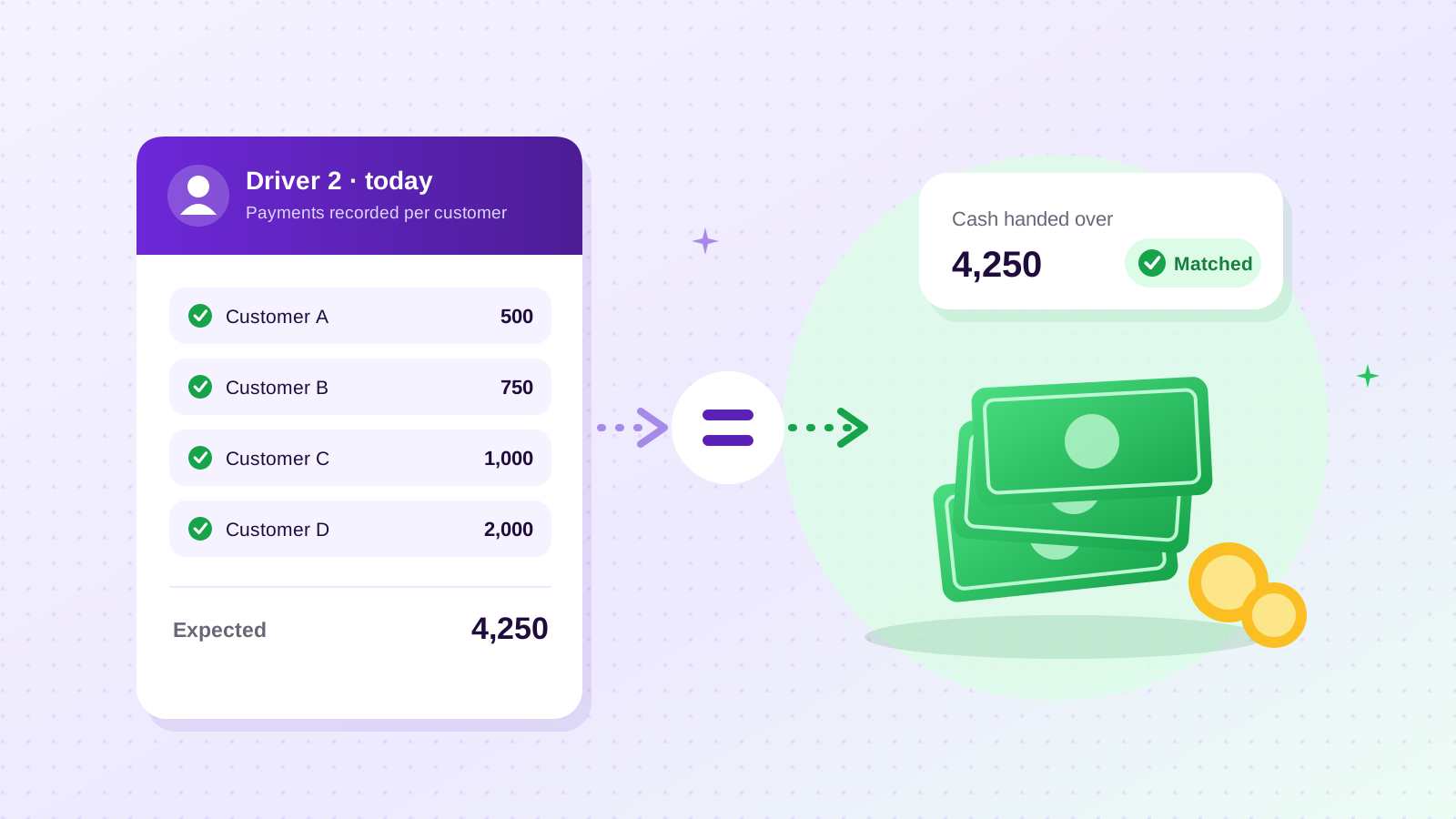
Delivery boys often collect cash and UPI payments at the door. At the end of the day, the cash handed over should match what customers paid. In practice the evening reconciliation is often a quick count and a rough memory of who paid. Small gaps go unnoticed, and over a month they add up.
How much of India's delivery supplier industry still uses manual accounting?
We looked for a reliable figure and could not find one. As of October 2026, we found no survey, government report or industry study that measures what share of Indian water, milk or gas delivery businesses keep their accounts manually. Any article that quotes a precise percentage for this group should be treated with caution.
What reliable data does exist describes the size of these markets and digital adoption among small businesses in general:
- Milk. India produced an estimated 247.87 million tonnes of milk in 2024-25, according to the Department of Animal Husbandry and Dairying's Basic Animal Husbandry Statistics 2025. That is production, not delivery businesses, but it shows how much milk moves through local supply chains every day.
- LPG. The Petroleum Planning and Analysis Cell's LPG profile counted 25,425 LPG distributors as of 1 October 2023, serving more than 31 crore active domestic customers (31.37 crore as of 1 January 2023). Those distributors run regular cylinder deliveries at a very large scale.
- Small businesses and the internet. The government's Annual Survey of Unincorporated Sector Enterprises 2023-24 found that 26.7% of unincorporated non-agricultural establishments used the internet, up from 21.1% the year before. This covers all kinds of small businesses, not suppliers specifically, and internet use is not the same as digital bookkeeping.
- Accounting software. PayNearby's MSME Digital Index 2024, a survey of more than 10,000 retail MSMEs such as kirana and medical stores, reported that about 29% used accounting software. It is a company survey of retail shops, and reports differ on whether the 29% is of all respondents or only those already using technology.
What these numbers suggest, without proving it, is that digital record-keeping among India's small businesses is growing but far from universal. It is reasonable to expect many delivery suppliers are still on registers and WhatsApp. It is not accurate to put a number on it.
Why growing delivery businesses need a better system
The register itself is not the problem. The problem is that a register can only answer the questions you ask it slowly, one page at a time. Is this customer's balance correct? Which recurring orders are due tomorrow? How much cash should Ravi bring back tonight? Each one needs someone to sit down and work it out.
A digital system changes three things:
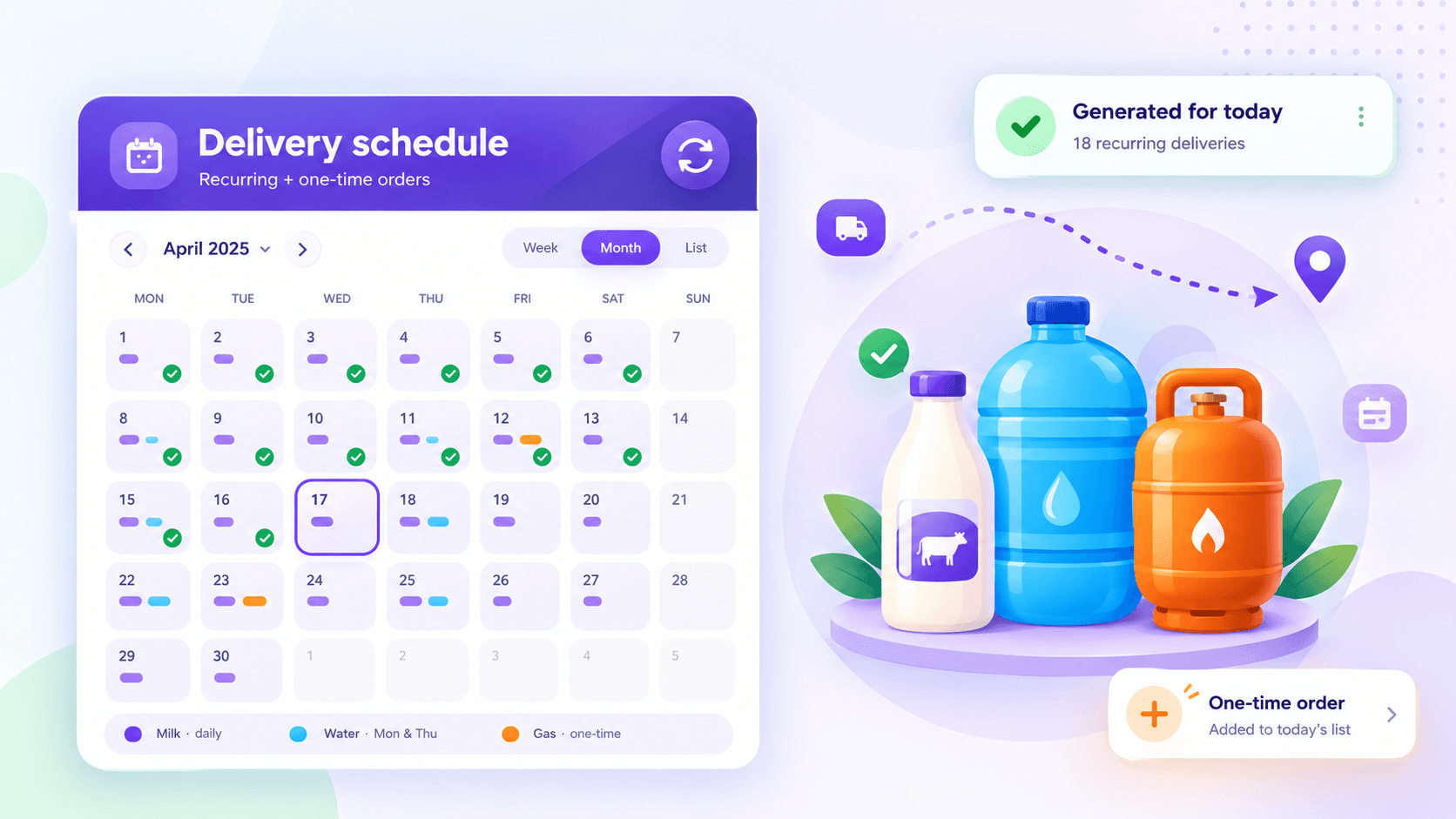
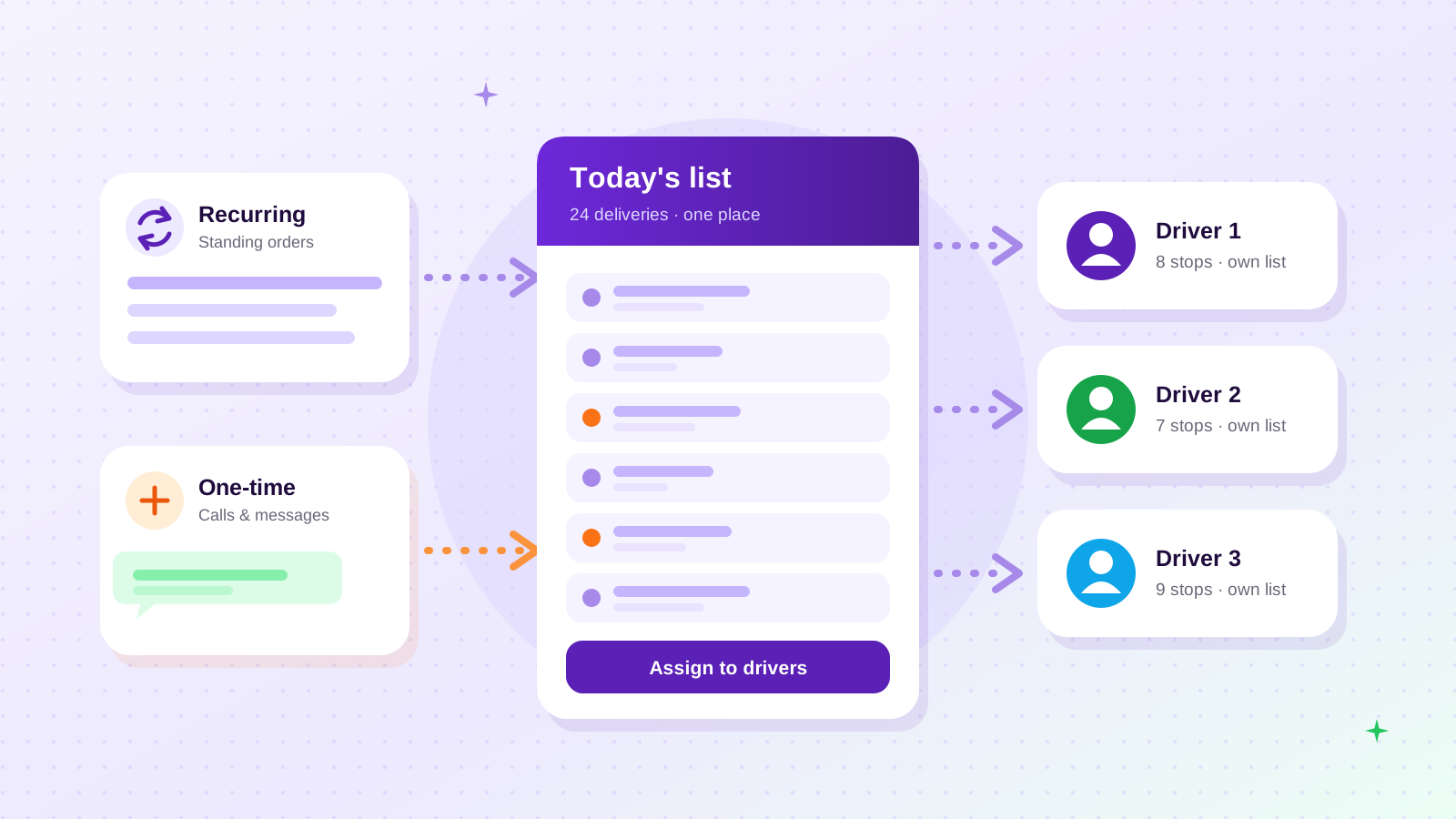
- Routine orders are set up once. A daily milk order or a twice-weekly water order is entered as a schedule, and each day's orders are created from it. Nobody has to remember to add them. Our guide to managing recurring deliveries and one-time orders together explains this method in detail, with or without software.
- Every delivery and payment is recorded against a customer. Balances update as you go, so the month-end total is already there.
- Everyone works from the same list. The owner, the delivery boys and, if you choose, the customers see the same orders, so far fewer things are lost in calls and chats.
None of this guarantees more customers or higher profit. What it can do is take repetitive record-keeping off the owner's plate and make mistakes easier to spot.
How 4Supplier helps suppliers manage daily operations
4Supplier is a mobile app built by Nsians for businesses that deliver products like water, milk, gas cylinders or food, on a schedule or on demand. It supports Indian rupees. The short product pages are suppliers in India, water, milk and gas. Here is what it does today, and what it does not do.
Customers. Each customer has a profile with contact details, one or more delivery addresses, order history, total spent, unpaid balance and any security deposit, such as for jars or cylinders.
Products. You add your own products and sizes, for example a 20-litre jar, a 500 ml milk packet or a 14.2 kg refill, each with its own price.
Recurring orders. You set up a repeat delivery for a customer once, and the app creates each order on schedule. Recurring deliveries can be paused or cancelled when a customer goes away or stops.
One-time orders. Extra or occasional orders go into the same order list as recurring ones, with recurring orders clearly marked. You can filter the list by all, unassigned, pending and completed orders.
Online ordering by customers. Customers you invite can use the customer side of the app to place one-time orders, set up recurring deliveries on the weekdays they choose, see their orders and check their payment history. Customers don't have to use it; you can run everything from your own account.
Delivery staff. Each delivery person has their own login and sees only the orders assigned to them. You assign or reassign orders from your phone and see when deliveries are completed.
Billing, credit and collections. A wallet records income, expenses, customer payments, deposits and the cash each delivery person collects and hands over. Each entry is linked to a customer, an order or a delivery person, and a customer's unpaid balance goes down when you record their payment.
To be clear about the limits: 4Supplier records payments, including cash and UPI you have received, but it does not process UPI, card or bank payments itself. It does not optimise routes, track delivery staff by GPS or generate GST invoices. It is being built for Android and iOS and is not yet on Google Play or the App Store. You can see how it works step by step or browse the app screens.
An example of a supplier using 4Supplier
This is an illustrative example, not a real customer.
Imagine a family business in a mid-sized city with about 180 customers. It delivers milk every morning to about 120 households, 20-litre water jars to 50 homes and offices on fixed weekdays, and gas cylinders to a handful of restaurants when they call. There are two delivery boys and the owner.
Setting up. The owner adds the products (milk packets, water jars, cylinder refills) with current prices. Each customer is added with their address and standing order: "1 litre milk daily", "2 jars every Monday and Thursday". Old balances stay in the register until they are settled, so the app starts with a clean record from day one.
Each morning. The day's recurring orders are already in the list. The owner adds the one-time orders that came in overnight, such as an extra jar for a flat or a cylinder for a restaurant, and assigns everything between the two delivery boys. Each delivery boy opens the app and sees only their own deliveries.
During the day. Deliveries are marked as completed as they happen. When a customer pays cash or by UPI at the door, the payment is recorded against that customer.
In the evening. The owner compares what each delivery boy recorded as collected with the cash handed over. Any difference shows up the same day, while everyone still remembers the deliveries.
At month end. Because every delivery and payment was recorded against the customer, each household's balance is already up to date. The owner follows up only with customers who still owe money, rather than recalculating 120 bills by hand.
Holidays. When a customer calls to pause milk for a week, the recurring delivery is paused rather than deleted, so it is not forgotten when they return.
Benefits for growing suppliers
Used consistently, a delivery management app can bring these benefits. They are possibilities, not guarantees.
- Records you can trust. Customer details, orders and balances live in one place instead of a register, a phone and a chat history.
- Fewer missed recurring deliveries, because routine orders are generated from schedules instead of memory.
- Fewer routine calls, especially if regular customers place or change their own orders.
- Clearer credit. You can see who owes how much without flipping pages.
- Visibility into delivery staff and the cash they collect, on the same day.
- More of the owner's time for finding new customers, rather than chasing records.
How to choose the right delivery management software
Whichever app you look at, ours or another, check it against this list. Ask for a demo or a trial, and test it with a few real customers before moving everything over.
- Customer records. Does each customer have a profile with addresses, order history, balance and deposits?
- Recurring orders. Can you set daily, specific-weekday and weekly schedules? Can you pause, skip or change them without deleting anything?
- One-time orders. Do they go into the same list as recurring orders?
- Your products. Can you add your own products, sizes and prices, and handle more than one product type (milk and water, for example)?
- Billing and credit. Does every delivery and payment update the customer's balance? Can you record partial payments?
- Delivery staff. Does each delivery boy get their own login and list? Can you see what has been delivered and what each one collected?
- Customer ordering. Can customers place or change orders themselves, and is it optional for them?
- Payments. Does the app only record payments, or does it collect them? Both are fine, but know which you are getting.
- Ease of use. Will your delivery staff actually use it on their own phones? Try it with them.
- Language and currency. Does it show rupees? Does it work in the language your staff are comfortable with?
- Data and privacy. Who can see your customer data? Can you get it out if you leave?
- Price and support. Is the pricing clear for a business your size? Who do you contact when something goes wrong?
- Tax needs. If you need GST invoices, check this specifically. Not every delivery app provides them.
If you are a water supplier still deciding how to set up the business itself, our guide on how to start and run a water delivery business covers pricing, deposits and drivers in more depth.
Frequently asked questions
What is delivery management software?
It is an app or online system that keeps your customers, orders, deliveries and payments in one place. For suppliers with regular customers, the most important parts are recurring orders, a daily delivery list for each delivery person, and an accurate balance for each customer.
Which software can help manage a water delivery business in India?
Look for an app that handles recurring jar deliveries, one-time orders, jar deposits, delivery staff and customer balances, and that works in rupees. 4Supplier is one option built for this. Compare a few against the checklist above before deciding.
How can milk suppliers manage daily recurring orders?
Record each customer's standing order once, as a schedule, and generate each day's deliveries from it. Handle holidays as pauses rather than cancellations, and record extra packets as separate one-time orders, so the monthly bill adds up correctly.
How can suppliers track customer credit and outstanding payments?
Record every delivery amount and every payment against the customer as it happens, whether it is cash, UPI or bank transfer. Then the outstanding balance is always current. Review balances weekly, oldest first, so small amounts don't grow.
How can delivery businesses manage recurring and one-time orders together?
Keep both in the same daily list. Recurring orders come from schedules; one-time orders are added as they arrive. Then assign the whole list to your delivery staff, so nothing depends on merging two lists by hand.
How can suppliers track delivery staff and daily collections?
Give each delivery person their own list, have them mark deliveries as completed, and record each payment they collect against the customer. At the end of the day, compare the recorded total with the cash handed over.
Can customers place orders online?
In some apps, yes. In 4Supplier, customers you invite can place one-time orders and set up recurring deliveries from the customer side of the app. Using it is optional, so customers who prefer to call can keep doing that.
What should I check before choosing a delivery management app?
Recurring and one-time orders in one list, customer balances, delivery staff logins, ease of use for your team, rupee support, data privacy, clear pricing and support. If you need GST invoicing or payment collection, confirm those specifically.
From manual coordination to organised operations
Registers, calls and WhatsApp got most delivery businesses started, and there is no shame in them. But once you have more customers than you can hold in your head, the cost shows up as missed deliveries, unclear balances and evenings spent reconciling cash.
The fix is the same whatever you deliver: set routine orders up once, put every order in one daily list, give each delivery person their own deliveries, and record every payment against a customer. Software makes that routine easier to keep.
If you want to run that routine from your phone, see what 4Supplier can do, or email info@nsians.com to ask whether it fits your business.