Driver Cash Collection and Handover: A Daily Routine That Adds Up
A simple end-of-day routine for counting the cash your drivers collect, with a worked example covering float, part payments, old balances and expenses.
By 4Supplier · · 7 min read

Record each collection and handover so the evening count can be checked against the day’s records.
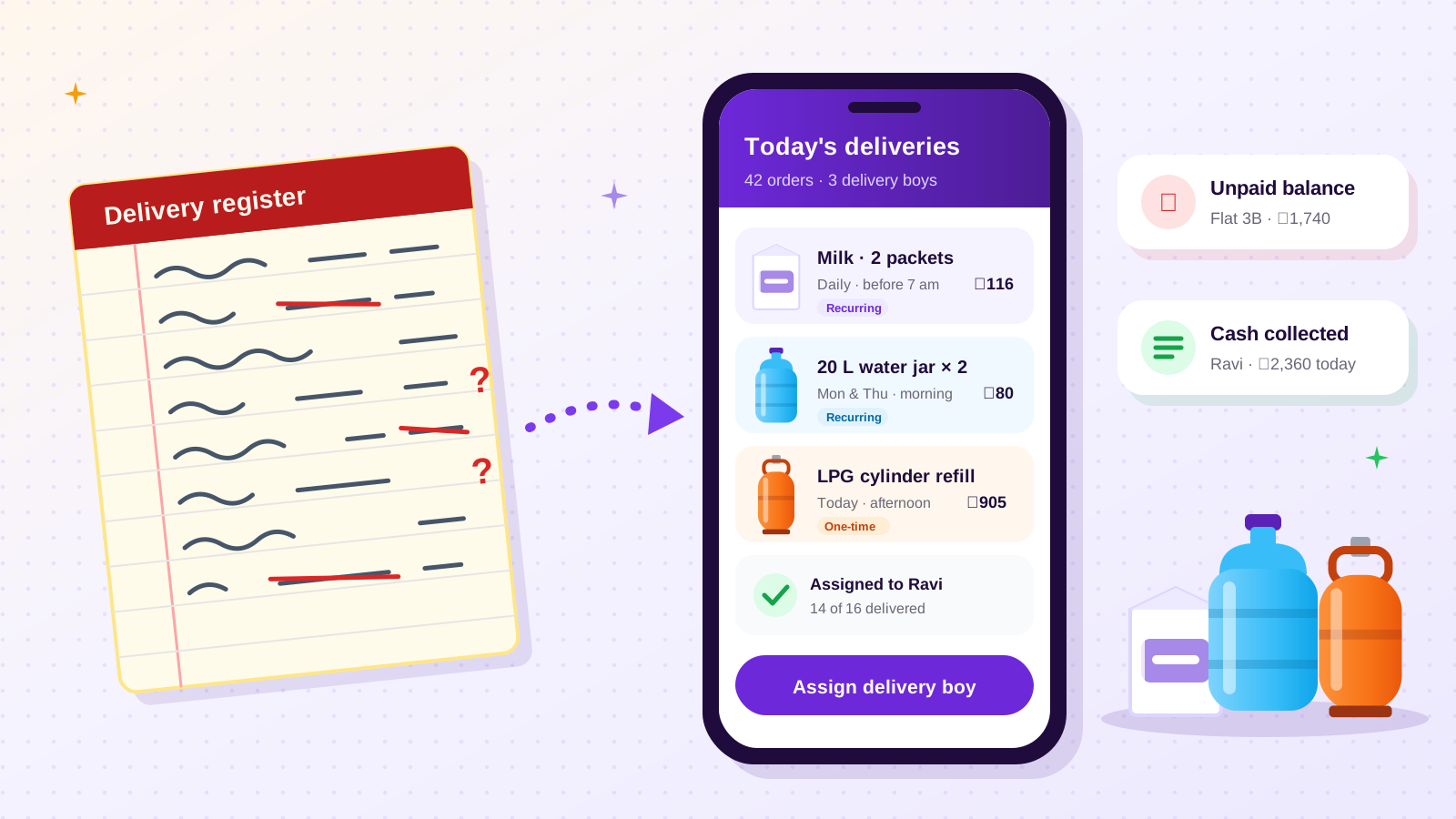
AI-generated editorial illustration made in Google Flow. Not a customer photo, product screenshot, or app screenshot.
If your drivers collect cash at the door, every one of them is carrying a small till around town all day. Customers pay for today's bottles, settle part of last month, or hand over a lump sum for an old balance. Some of that cash goes on fuel before it reaches you. By evening, the number in the driver's pocket rarely matches the number in your head, and without a method it is hard to tell a missing receipt from a real loss.
This guide sets out one routine that works for water, milk, gas or any round where drivers collect cash. It needs a clear rule for float, a record of every payment as it happens, and a single sum you run per driver every evening.
Why the evening count so often disagrees
A mismatch can come from incomplete records. Check those before drawing conclusions. Common sources of a difference include:
- A payment was taken but never written down, or written against the wrong customer.
- A customer paid part of what they owed, and the record shows the full amount.
- A customer paid for an old balance without taking a delivery, and nobody recorded it because "there was no order".
- The driver already handed some cash over at midday, and the evening count forgets it.
- Fuel or another approved cost was paid from collections without a receipt.
- The change float was counted as takings, or the takings were counted as float.
- An order was marked "cash" but the customer paid another way, or the delivery did not happen.
Each of these produces a difference that disappears once the record is corrected. That is why the count comes after the records are checked, not before.
Set the rules before you count anything
Write these down once and give them to every driver:
- Float. Decide how much change each driver starts with and whether it stays with them overnight or comes back every evening. Either is fine, but the sum is different, and mixing the two up can create a difference equal to the float.
- Every payment is recorded when it is received, against the customer who paid, with the actual amount. A part payment is recorded as the part, not the total.
- Old-balance payments are payments, not deliveries. When a customer pays down what they owe without taking anything, record the payment against their balance.
- Spending from collections needs approval and a receipt. Agree what drivers may pay for on the road (fuel, a puncture, parking) and that each spend is recorded as its own line.
- Every handover is recorded, including a midday drop-off, with the time and amount.
- Tips — decide whether they belong to the driver. If they do, they stay out of the count.
The one sum to run for each driver
For each driver, each day:
Expected cash in hand = opening float + cash collected − cash already handed over − approved spending
Then, if the float stays with the driver:
Expected evening hand-in = expected cash in hand − float kept by the driver
"Cash collected" means every cash payment recorded that day: today's deliveries, part payments and old balances. It does not include orders that were not delivered, or payments made by bank transfer or mobile wallet, which belong in your bank reconciliation instead.
The difference between what is counted and what was expected is the variance. A variance is a question to answer, not a verdict.
A worked example
The figures are illustrative, in any currency. A driver starts the day with 1,000 in change. Your rule is that the float stays with the driver overnight.
During the day the driver records:
| Item | Amount |
|---|---|
| Cash for today's deliveries, paid in full | 3,200 |
| Part payment: a customer who owed 1,500 paid 600 | 600 |
| Old balance: a customer paid 2,000 without taking a delivery | 2,000 |
| Cash collected | 5,800 |
| Midday handover to the owner | 3,000 |
| Fuel, approved, receipt kept | 450 |
Expected cash in hand at the end of the day:
1,000 + 5,800 − 3,000 − 450 = 3,350
The driver keeps the 1,000 float, so the expected evening hand-in is 2,350.
The driver hands over 2,250. The variance is 100 short. Before anyone talks about missing money, check:
- Was a part payment recorded as a full payment somewhere?
- Is there a second receipt for something approved, such as parking?
- Did a customer pay by transfer and get recorded as cash?
- Is the float really 1,000, or did the driver start with less?
Suppose the driver finds a 100 parking receipt that was never recorded. Once the spend is added, expected hand-in becomes 2,250 and the variance is zero. The cash was never missing; the record was.
Check the whole day as well. Total handed over (3,000 + 2,250 = 5,250) plus approved spending (450 + 100 = 550) equals cash collected (5,800). The float of 1,000 sits outside both, because it was never takings.
What to do with a difference that remains
If the records are right and a difference remains:
- Note it against the driver and the day, with the amount and what was checked.
- Talk to the driver the same evening, while the round is still fresh. Ask which stops paid cash and how much.
- Ask the customers concerned, if needed. A customer who says "I paid" and a record that says "unpaid" is cheaper to settle this week than next month.
- Decide in advance how you will review differences. Small amounts may be change or rounding, but review them rather than assuming they are harmless, and look closely at any repeated pattern or large difference.
- Do not change a customer's balance or an order just to make the cash match. That moves the difference somewhere you will not find it later.
A short evening routine
- Each driver confirms their deliveries for the day are marked correctly, including any that did not happen.
- Each driver checks the payments they recorded, especially part payments and old balances.
- Add any approved spending with its receipt.
- Count the cash together, or on camera, and record the counted amount, not the expected one.
- Record the handover.
- Note any variance and what was checked.
A consistent routine makes it easier to spot and resolve differences while the day is still fresh.
How 4Supplier records driver cash
4Supplier is built around this routine. In the app's current source (not yet tested in production):
- A driver can record cash they collected against a delivered order that was on credit, or against what the customer owes overall.
- The customer's unpaid balance goes down when the payment is recorded.
- That cash then shows as held by the driver. It is not added to your own records until you record the handover.
- When you record a handover from a driver, the amount held by the driver goes down and the money appears in your income records.
- You can record your own business expenses, for example fuel, in your records.
The app keeps records. It does not collect or move money, and it does not take card or mobile payments. Each driver sees only the orders assigned to them.
The app's "held by driver" figure is cash they collected. Your change float is separate, so keep your float rule written down alongside it.
You can read how this fits a Pakistani water round in our Pakistan water supply guide, how recurring and one-time orders share one list in managing recurring deliveries and one-time orders, or see the water, milk and gas pages.
The 4Supplier website currently invites suppliers to register launch interest by email: Email me at launch.
Frequently asked questions
Should the change float come back every evening?
Either way works. Returning it each evening makes the count simpler. Leaving it with the driver saves time in the morning. Pick one rule and use it for every driver.
How do I record a customer who pays only part of what they owe?
Record the amount actually paid against that customer. Their balance should still show the rest as owed.
A customer paid an old balance but took no delivery. Is that a delivery?
No. Record it as a payment against their balance. It still counts as cash collected by the driver that day.
Does a short count mean the driver took the money?
Not necessarily. Check payments, receipts and float before drawing conclusions.
Further reading
- How do small delivery companies track cash collected by drivers? — a discussion on Reddit's r/smallbusiness about end-of-day cash mismatches with around ten drivers.
- Driver Cash at the End of the Night: Reconciling Delivery Money Without Guessing — TeamBooks blog, 10 October 2026.
- Managing Cash on Delivery in a Water Business — Mashqi blog, 8 June 2026.